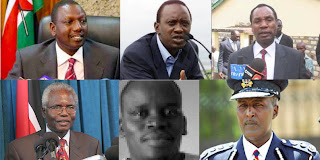
Just imagine the fear that grips innocent people when they show up at a local magistrate’s court, then increase it a hundredfold for appearing before three judges in a faraway international court with windows frosted by snow. The country is duty-bound to ensure that the six Kenyans named as suspects by the Chief Prosecutor of the International Criminal Court are steeled for a long and rigorous trial lest they start building an inexplicable puddle of cowardice at their feet in the courtroom. Kenya’s image as the home of the brave Maasai warriors would be irrevocably soiled, with obvious ruinous consequences for tourism.
Tuesday, December 28, 2010
If we're assisting IDPs, we must also assist Ocampo 6
Just imagine the fear that grips innocent people when they show up at a local magistrate’s court, then increase it a hundredfold for appearing before three judges in a faraway international court with windows frosted by snow. The country is duty-bound to ensure that the six Kenyans named as suspects by the Chief Prosecutor of the International Criminal Court are steeled for a long and rigorous trial lest they start building an inexplicable puddle of cowardice at their feet in the courtroom. Kenya’s image as the home of the brave Maasai warriors would be irrevocably soiled, with obvious ruinous consequences for tourism.
Posted by
Amkeni Ndugu Zetu!
at
22:02
0
comments
Labels: Ocampo 6
Wednesday, December 22, 2010
BREAKING NEWS: Internal Security minister names Kenya's Drug Lords
George Saitoti has revealed in Parliament that MPs Gidion Mbuvi, William Kabogo, Hassan Joho and Harun Mwau are among the 6 drug lords under investigation for drug trafficking. We'll keep you posted as details become available.
UPDATE: Juja MP William Kabogo (snitch?) tabled documents claiming they contained the names of Simon Mbugua (Kamukunji) and Eugene Wamalwa (Saboti), also believed to be in the dossier in Prof. Saitoti's possession. He added that a wife of a prominent Kenyan was also on the list. Mr Kabogo was categorical that the list he tabled was from the American Embassy. The MPs in the list defended themselves with Mr Kabogo and Mr Joho insisting that those who had mentioned them should also be investigated for "peddling falsehoods". They said they welcomed thorough investigations. Mr Joho demanded unsuccessfully that his name be expunged from the list until investigations are concluded, stating that it was scandalous and meant "to kill others politically". He demanded that the minister undertakes that if he is found innocent, those who named be made to face the full force of the law.
Meanwhile, we're reliably informed that Sonko is Mwau's illegitimate son and Kabogo is his son-in-law! Can anyone confirm?
Posted by
Amkeni Ndugu Zetu!
at
16:56
0
comments
Labels: Drug Lords Revealed
Ruto's ICC motion bites the dust
UPDATE: MPS approve motion to repeal International Crimes Act and ask the government to withdraw Kenya from the Rome Statute (Wednesday 22nd December, 9:12pm).
Posted by
Amkeni Ndugu Zetu!
at
13:08
0
comments
Labels: Hague 6, When it rains it pours
Tuesday, December 21, 2010
Harry Potter actress beaten by family for dating a non-muslim
Afshan Azad, 22, starred as Padma Patil, one of Harry Potter’s classmates, in four of the franchise hit movies made from the books by JK Rowling. The Daily Mail reports that the star’s father, Abul Azad, 54, and brother, Ashraf, 28, allegedly attacked her, called a her 'prostitute' and threatened to kill her after she met with a young Hindu man. Azad reportedly escaped further assault by climbing through a bedroom window. Azad’s brother pleaded guilty to assault, and both her father and brother were found not guilty of making threats to kill.
The court was told Azad, who lives with friends in London, would not attend the Manchester trial voluntarily. She had given a statement to the lawyer representing her father and brother which read: “I dearly love my father and brother. The proceedings have caused me no end of distress and if it goes ahead, it will make things much worse for me.” Azad played a witch of the same age as Harry Potter in the hit franchise, and first appeared in Harry Potter And The Goblet Of Fire. She also starred in the final instalment, Harry Potter And The Deathly Hallows.
Posted by
Amkeni Ndugu Zetu!
at
17:51
0
comments
Museveni's phobia of "Jaluos" explained
Ms Kathleen FitzGibbon, the former political affairs officer at the US Mission in Kampala, detailed the President’s phobia in a June 29, 2009 dispatch to Washington, made public by whistleblower Wikileaks website. The publication of the cables comes only a few days after Mr Odinga visited Uganda for talks with President Museveni – and then drew criticism from the opposition after he accompanied Mr Museveni to the campaign trail.
The leaked cables provide progress updates on a regional anti-LRA rebel offensive in the Democratic Republic of Congo led by Uganda, but raises official uneasiness about bonding of Luo communities across the region. The cables reveal that UPDF Spokesman Lt. Col. Felix Kulayigye told Ms FitzGibbon last June that “Kenyan Prime Minister Raila Odinga may be making common cause with the Acholi opposition in Uganda and Diaspora elements in Nairobi to advocate on behalf of LRA leader Joseph Kony”. It adds: “Kulayigye said the government suspects Odinga of supporting the Ugandan opposition because President Museveni supported Kenyan President Kibaki during the Kenyan elections.”
The Defence and Military spokesman confirmed to Uganda's Daily Monitor newspaper last night that he did discuss the subject captured in the cable but said the reporting by the diplomat had “a spin”. He said their talk centred on a letter written by former LRA negotiator, Mr Ayena Odongo, in which he “requested the Rt. Honourable Raila Odinga to intercede on their behalf to US President Obama”. Lt. Col. Kulayigye said: “Whether the Prime Minister wrote the letter or not, I don’t know.” However, the cable suggests the Kenyan leader notified Mr Obama requesting the US stops its operations against the LRA.
Mr Odinga, an ethnic Luo, reportedly is attempting to unite the Luo-speaking communities of western Kenyan, south Sudan and northern Uganda, Mr FitzGibbon noted, without giving reason for the rallying call.
"Kenyan Prime Minister Raila Odinga may be making common cause with the Acholi opposition in Uganda and Diaspora elements in Nairobi to advocate on behalf of LRA leader Joseph Kony”. It adds: “Kulayigye said the government suspects Odinga of supporting the Ugandan opposition because President Museveni supported Kenyan President Kibaki during the Kenyan elections.
Relations between Mr Museveni and Mr Odinga were tested in late 2007/early 2008 when the Ugandan leader became the first and only President in the region to congratulate President Mwai Kibaki after the Kenyan leader was hurriedly sworn-in amidst allegations of electoral fraud. Hundreds of Kenyans were killed in the post-election violence that ensued and although Mr Odinga joined government in a power-sharing deal, many in his camp believed that Mr Museveni’s decision had strengthened Mr Kibaki’s hand. Widely-reported claims that Uganda deployed troops across the border in support of Mr Kibaki have never been independently verified. State House Entebbe last night said even if the mood of mistrust captured in the US diplomatic cables was true; things have since changed for the better.
“What is important is that President Museveni is working very well with Prime Minister Odinga and other Kenyan leaders. We should not be diverted by [foreign] interests,” said Presidential Spokesman Mirundi Tamale. “Politics changes and things in it are determined by the prevailing interests,” he said, describing Mr Odinga as “serious, calculative contender” for Kenya’s leadership.
In Nairobi, Mr Odinga’s spokesman, Mr Dennis Onyango, reportedly said the Prime Minister would not respond to “every line that rolls out of Wikileaks. That is the essence of freedom of expression.”
Posted by
Amkeni Ndugu Zetu!
at
17:19
0
comments
Labels: WikiLeaks
Wednesday, December 15, 2010
Kibaki shocker as Ocampo names The Hague 6
In a statement sent from State House on this afternoon, the Head of State said calls for action against those named were “prejudicial, pre-emptive and against the rules of natural justice.”
“They cannot be judged as guilty until the charges are confirmed by the court,” the President said.
He pointed out that those mentioned had not yet been fully investigated as the pre-trial process in The Hague had only begun and should therefore not be condemned. President Kibaki repeated the government's commitment to establish a local judicial mechanism to try those behind the post election violence. "As a nation we must also focus on the need for national healing and reconciliation. This is paramount as we move forward on the path of national peace and unity."
Those in the list of six unveiled by Mr Ocampo include Deputy Prime Minister and Minister for Finance Uhuru Kenyatta, suspended Higher Education Minister William Ruto and Industrialisation Minister Henry Kosgey.
The others are Head of the Civil Service Ambassador Francis Muthaura and former Police Commissioner Major General (Rtd) Mohammed Hussein Ali as well as KASS FM radio presenter Joshua arap Sang.
On Monday the Cabinet held an unusual meeting and agreed to form a local tribunal to try perpetrators of the post election violence.
However, the decision was criticised by Kenyans especially members of the civil society who said establishing a local tribunal would not deter the ICC process since it was dealing with high level perpetrators.
Mr Ocampo said Kenya was free to investigate other perpetrators if it so wishes but vowed to continue pursuing his list of six.
Earlier on Wednesday, Members of Parliament initiated a process for Kenya to pull out from the Rome Statute and block ICC from investigating the 2008 post election violence.
Chepalungu MP Isaac Ruto moved a Motion that seeks to bar Mr Ocampo from prosecuting suspected masterminds of the violence and allow for a local judicial process.
Even if Kenya withdraws from the Rome Statute, ICC cannot stop its process.
Posted by
Amkeni Ndugu Zetu!
at
18:07
0
comments
Labels: Hague Wednesday, Siku za mwizi ni 40
BREAKING NEWS: Ocampo's 6
3. Henry Kosgey, Minister of Industrialization, MP, Tinderet.
4. Amb. Francis Muthaura, Head of Public Service and Secretary to the Cabinet
5. Joshua arap Sang, Senior Editor, KASS FM.
6. Maj. Gen. Hussein Ali, former Police Commissioner.
Posted by
Amkeni Ndugu Zetu!
at
14:19
0
comments
Labels: Hague Wednesday, Siku za mwizi ni 40
BREAKING NEWS: Security tightened as Kenya awaits Ocampo's announcement
Posted by
Amkeni Ndugu Zetu!
at
14:05
0
comments
Labels: Siku za mwizi ni 40
Tuesday, December 14, 2010
Kenya 2.0 - Judgement Day
The announcement came as officials confirmed on Saturday night that Mr Moreno-Ocampo would go ahead with his decision to name suspects behind the 2007/8 post-election violence on Wednesday, ignoring spirited attempts to halt the process. The development will represent the most dramatic attempt to tackle an entrenched culture of political violence cited as one of the greatest threats to stability in Kenya. No senior figures have ever been held to account for cyclical waves of violence that have cost the country thousands of lives in the last three decades. An ICC official said a series of applications lawyers have attempted to file at The Hague would not affect the process, adding that the case was in the hands of the prosecutor, and it was up to him to decide whether to halt the process before Wednesday. Lawyers for the suspects, he said, would have an opportunity to present their case to ICC judges after the case proceeds to the pre-trial chamber.
The naming of the suspects – who include top coalition leaders, businessmen and security chiefs – will be a development of historical significance. It is expected to trigger changes in the Cabinet within the next few weeks because serving public officers are expected to come under intense pressure to step down. Political realignments are also likely to follow, and some diplomats say there is a risk of low grade violence in some parts of the country. Kenya National Commission on Human Rights (KNCHR) commissioner Hassan Omar said the start of the prosecution process holds the potential to tackle impunity by demonstrating that senior government officials can be held to account for their conduct. “Those who have tried to politicise this process have done a great injustice to the victims. The perpetrators have shown they have no remorse for the crimes committed, for the numerous children killed, mothers raped and countless others displaced.
Speculation about the identity of the suspects has intensified with some sources at The Hague saying Kenyans might be surprised to learn the identities of “one or two of those included or omitted”. Another source of uncertainty is the likely reaction of some of the militia that remain loyal to the perpetrators. In a nation that is trying to consolidate the delicate peace deal that ended the 2007/8 standoff, some have warned of a fresh outbreak of violence. Outgoing European Union ambassador Eric van der Linden told Reuters he was confident Kenya’s political leadership would not allow the country to slide back into a state of widespread violence. But he said occasional flare-ups could not be ruled out. “We don’t expect violence when Mr Ocampo names names. There may perhaps be some very local reactions of discontent, possibly in the Rift Valley and perhaps in the Central province,” he said. A US embassy note to American citizens said they did not expect the ICC announcement to provoke an aggressive reaction. “However, the announcement may increase political tensions and tension can turn to violence with little or no warning,” the message said. Surveys show a solid majority of Kenyans – 68 per cent at the last poll – support ICC action. Those figures reflect widespread public frustration over the failure of Kenyan institutions, especially the Attorney-General’s office, to pursue prosecution of high-level suspects behind electoral violence. No one was held to account for the attacks leading up to the 1992 General Election that began with a wave of forced displacements three years earlier. The violent displacement of residents from Mombasa’s Likoni area in August 1997 also went unpunished. Both episodes were seen to have been sponsored by the State.
Political scientist Dr Tom Wolf, who consults for research firm Synovate, says there would be a new opinion poll in the next few weeks to gauge public reaction to the naming of the so-called Ocampo Six. “It will be important to track public opinion because we will only begin to know the actual content of the prosecutor’s case once the actual names are presented. Although Ocampo describes his work as entirely a judicial process, for Kenyans it is also a highly political one especially when viewed through the lens of its potential impact. And it is also a social one on how Kenyans view each other and live with each other. For survey researchers and other analysts it will be important to pay close attention to how Kenyans are reacting.” The Kenya case was referred to The Hague by chief mediator Kofi Annan after local authorities failed to establish a special tribunal to try the suspects.
Posted by
Amkeni Ndugu Zetu!
at
15:44
0
comments
Labels: Malipo ni papa hapa, Ocampo 6
Monday, December 13, 2010
What the U.S. thinks of M7 - WikiLeaks
“They control no government ministries, and are not skillful using either the press or protest, their primary political tools,” he wrote.
The leaked diplomatic cables, published yesterday by The Guardian newspaper, reveal Mr Lanier’s discussions on human rights abuse, war crimes and corruption. Writing on October 19, 2009, ahead of a crucial visit by US Assistant Secretary of State Johnnie Carson to Kampala, Mr Lanier noted that although Uganda had become a confidant and outspoken regional leader under President Museveni, the NRM leader’s “autocratic tendencies” were threatening to move the country in reverse gear.
“The President’s autocratic tendencies, as well as Uganda’s pervasive corruption, sharpening ethnic divisions and explosive population growth, have eroding [sic] Uganda’s status as an African success story,” wrote Mr Lanier. The US envoy noted, however, that holding “a credible and peaceful” election in February 2011 could “restore Uganda’s image” but failing to do so “could lead to domestic political violence and regional instability”.
Mr Lanier’s private observations were made less than two months after he arrived to his new posting in Uganda with authorities in Kampala describing him as a “very good” choice. With a diplomatic career spanning some 26 years, Mr Lanier replaced Amb. Steven Browning who left Uganda in July 2009. In the cable to Mr Carson, Mr Lanier also referred to the September riots and the killing of several civilians who were protesting a decision by the government to block Kabaka Ronald Mutebi from travelling to Kayunga and expressed criticism of President Museveni’s NRM government before concluding that “press reports and anecdotal evidence suggest the President is increasingly isolated and unaware of the depth of resentment both within the NRM and among society as a whole”.
“Then NRM’s near total accumulation of power has led to poor governance, corruption, and rising ethnic tensions, a combination that threatens Ugandan ‘democracy and stability,” he noted. The government yesterday moved to dismiss the contents of the leaked cables. In a separate cable, however, US concerns about possible war crimes committed by the UPDF in its fight against rebels of the Lord’s Resistance Army with the aid of US supplied intelligence are revealed. Mr Lanier curiously wrote that he had in fact warned Uganda to let the US know in advance when the UPDF intended to commit war crimes using American intelligence.
In the December 16 memo, Amb. Lanier reported to Washington that Defence Minister Crispus Kiyonga had verbally assured him that US intelligence was being used “in compliance with Ugandan law and the law of armed conflict. This pledge includes the principles of proportionality, distinction and humane treatment of captured combatants.” But just a day later, Mr Lanier authored another memo revealing US concerns over alleged human rights abuse, citing the case of an LRA colonel who had been killed eight years ago, at a time when the Rome Statute, the instrument that created the International Criminal Court of which Uganda is a signatory, had come into effect. He reported that Col. Peter Oloya, who had been jailed in Gulu had been shot on the orders of then UPDF northern Uganda intelligence coordinator Col. Charles Otema, now a brigadier, on July 1, 2002.
“I dismiss those statements with the contempt they deserve,” said UPDF spokesman Lt. Col. Felix Kulayigye, reacting to Ambassador Lanier’s memo. “It is erroneous for anyone to claim that Uganda got US intelligence in 2002. The Americans only offered us intelligence for Operation Lightning Thunder in 2008.” Discussing the Oloya killing, Lt. Col. Kulayigye said the LRA rebel was shot as he tried to escape from jail.
“Brig. Otema isn’t stupid to call for someone and then have him killed,” he said.
“That individual was under detention and tried to ran away and was shot. Ambassador Lanier was not in Uganda at the time of this incident.”
Posted by
Amkeni Ndugu Zetu!
at
14:03
0
comments
Labels: WikiLeaks
Kenya's cabinet most corrupt in Africa - ambassador Ranneberger
They cite corruption-related investigations currently under way against him and his past record as a public official. They also claim some reports have linked him to post-election violence. “Kosgey’s diverse corruption activities over decades have negatively impacted US foreign assistance goals in a number of ways. His continuing ownership of illegally transferred forest lands, part of the greater Mau Forest which comprises Kenya’s largest water catchment area, has contributed to ethnic conflict over land ownership in the Rift Valley, and has also contributed to deforestation and resulting drought and hunger that currently plagues Kenya. Donors, including the United States, have had to provide billions of dollars in emergency food aid to Kenya over the last four years of chronic drought,” the cables state.
The latest batch of cables was released by German newspaper Der Spiegel, one of five publications given the package of cables containing up to 250,000 dispatches sent from US embassies around the world. The US embassy in Nairobi appears to have focused on investigation of high-level corruption in recent years. The cables paint a positive profile of the new KACC chief, who has won praise for the way he has set about pursuing top officials suspected of crimes. Foreign minister Moses Wetang’ula, permanent secretary Thuita Mwangi and Nairobi mayor Geophrey Majiwa were recently forced out of office due to corruption allegations. US ambassador Michael Ranneberger reported that he was impressed by Prof Lumumba’s first few weeks in office. But he charged that Mr Wako remained a major obstacle to reform, a statement he has made publicly in the past.
In a report compiled in September 2009, the US envoy charged that “Wako is largely responsible for the fact that no politician has ever been seriously taken to task for graft-related activities. Wako was originally appointed to the position by President Moi, but he held onto his office due to his excellent relationship with the country’s current president, Mwai Kibaki. And he shouldn’t expect much in the way of favours from the US,” says the report in Der Spiegel. Mr Ranneberger outlines a number of reasons why the US decided to ban Mr Wako from America. “The Embassy strongly believes Mr Amos Wako has engaged in and benefited from public corruption in his capacity as Attorney General for the past 18 years by interference with judicial and other public processes.”
The US accuses Mr Wako of sabotaging efforts to pursue justice for the victims of the unrest that afflicted Kenya in early 2008. According to a US dispatch on the matter: “One can find an Attorney General who has successfully maintained an almost perfect record of non-prosecution. He accomplishes this through the most complex of smoke and mirrors tactics, seeking to appear to desire prosecution while all along doing his utmost to protect the political elites.”
The fallout from the release of the cables continued yesterday as more ministers took up the subject. Internal Security minister Prof George Saitoti, who is also the acting Foreign minister, on Saturday said Kenya should not worry about the leaked cables since many other countries had been mentioned as well. “This is propaganda but we are not the only ones,” he said. Deputy Prime Minister Uhuru Kenyatta said the Americans were threatened by China’s rising influence. “The Chinese have provided funds for roads, hospitals and other projects but the complainants have nothing to show in this regard,” he said. Defence minister Yusuf Haji dismissed accusations that the defence council was populated by members of Mr Kibaki’s Kikuyu community. “Mambo ya huyu balozi ni ya sokoni na ya upuuzi (This is mere market gossip). I am the chairman of the defence council, Joseph Nkaissery is a member, David Musila is a member and the head of the army (Jeremiah Kianga) is a Kamba,” he said.
Despite the heated reaction from the Cabinet, Prime Minister and President, the release of the cables is likely to cement Kenya’s reputation as one of the most corrupt countries in the region. The Der Spiegel report says corrupt “government (officials) often trigger famines and instigate unrest, which then must be mitigated with Western aid money. As such, diplomats have drawn up a list of the worst offenders. Fifteen high-ranking Kenyan officials have been banned from entering the US. “During the 24 years that Daniel arap Moi was president of Kenya, between 1978 and 2002, the entire body politic was gripped by a system of personal enrichment and corruption. Despite the fact that dozens of investigative commissions have thrown light on hundreds of cases of corruption, not a single minister has ever been convicted.” The report accuses Mr Ringera of working with KACC officials to entrench “a system that works to discourage investigation, minimise the likelihood of prosecution, and throw out court cases that appear to have a chance of taking down senior government officials.”
“Like the Attorney General, Ringera can claim a perfect record of not investigating and convicting a single Kenyan government official. This is a remarkable tally in a country that is consistently ranked among the most corrupt in the world.”
In a teleconference conversation with reporters yesterday Assistant Secretary of State Johnnie Carson downplayed the WikiLeaks revelations. He likened the contents of cables between US embassies in Africa and the State Department, to a married couple discussing a “mother-in-law or father-in-law, both of whom you love dearly. But you may in fact have some disagreements about the suits that they wear or the shoes that they put on in the morning”. He characterised the documents downloaded from US government computer systems as “stolen mail” that should not be relayed. Mr Carson, a former US ambassador in Nairobi, acknowledged that “embassies carry on candid, sensitive discussions with Washington and Washington officials.”
Posted by
Amkeni Ndugu Zetu!
at
13:54
0
comments
Labels: WikiLeaks
Friday, December 10, 2010
Cancer of clinging to power is spreading across Africa
Now Allasane Ouattara, the opposition leader who was declared the winner, must contend with guards from the United Nations holed up in some hotel, hoping Gbagbo will soon see sense, concede defeat and vacate the presidential palace for the rightful winner.
This latest African election fiasco speaks volumes about African rulers who feel uncomfortable leaving office by any other means other than death in office or being ousted from power by military might. They have put a low premium on democratic electoral process as a civilised way of changing regimes. This grand coalition mania that is slowly creeping in our political culture was actually invented, manufactured and patented in Nairobi Kenya; thanks to the efforts of the African Union, Kofi Annan and the United Nations.
Now the cancer is spreading across Africa. On December 27, 2007, President Mwai Kibaki did not win an election but was sworn in three days later at a controversial State House ceremony that was conducted under the cover of darkness. Not a single head of state was invited to the ceremony as had been customary in the past. In a matter of hours, Kibaki named his first cabinet of 17 ministers then barricaded himself at State House as post-election mayhem consumed many parts of the country.
In the latest case, Gbagbo refuses to accept defeat in the Ivorian elections. The sitting president chooses to go to court to overturn the country’s electoral body’s results, international observers’ verdict and the United Nations’ conclusion that had indicated that Allasane Ouattara the opposition candidate had beaten Gbagbo by a very wide margin.
Amidst all this confusion and stand-off, Gbagbo decides to be sworn in immediately at the Presidential Palace, the equivalent of our State House. Soon after, he names his cabinet as the winner is sill holed up in a hotel under heavy international security. In the Kenyan situation, much as no contender went to court to nullify the elections that were obviously disputed following delays in announcing the results, the Electoral Commission was finally forced into announcing the results later by the president’s men and women the in power.
Just minutes following this announcement, Kibaki was hurriedly sworn in at State House late in the evening. When the international community realised that Kenyans would not accept this blatant theft of their rights lying down, and as the masses started unleashing mayhem in most parts of the country including disrupting road and rail transport to East and Central Africa, did the East African Community, the AU and the rest of the world realise that Kenya had reached its tipping point with its election thefts.
Strangely for Kenya, the announced election results were neither accepted nor condemned by the international community. They opted for the third option and chose to bring the PNU and ODM to the table to negotiate power sharing! The reason they did this was because probably they knew that the Electoral Commission had mismanaged the process beyond recognition such that it was impossible to know who the real winner was.
This theory was confirmed months later by the Kriegler Commission when it concluded that it was impossible to know who won or lost Kenya’s 2007 elections.
However, the lingering question is why the international community chose to negotiate power sharing between the two main opponents when it could have easily forced a re-run between Kibaki and Raila Odinga. But again, considering the violent mood in the country at the time, another election might just have aggravated the already volatile situation. We may recall that soon after Kenya went through with the Grand Coalition government that finally included the third confirmed loser, Kalonzo Musyoka, another coalition government was in the offing in Zimbabwe where Mugabe’s ruling party had grown wild after apparently losing to his opponent Morgan Tsvangirai.
Rather than accept defeat, Mugabe refused to leave office and chose to form his government despite international condemnation that included more sanctions. Sooner rather than later, the AU- supported southern African states led by South Africa negotiated a Kofi Annan type of coalition government that forced Mugabe to share power with his erstwhile opponent in the government.
If Gbagbo stays put in his presidential palace despite international condemnation; if he refuses to listen the voice the US President, the UN Secretary General, the European Union, the AU and the ECOWAS, then the international community will be left with only two choices; either to use force and eject him from power or negotiate a power sharing deal similar to Kenya and Zimbabwe.
Knowing how the international community thinks, another war in Ivory Coast would not make economic sense. They would definitely opt for the Kenyan template and accept Gbagbo as the Ivorian president for another five years despite having lost an election.
Posted by
Amkeni Ndugu Zetu!
at
13:15
0
comments
Labels: Death to the dinosaur
Thursday, December 9, 2010
Museveni feared plot by Gaddafi to kill him - WikiLeaks
The damning revelation is contained in one of two classified memos on Uganda in which the private observations of top American diplomats are made public by controversial whistleblower website, WikiLeaks.
Mr Museveni’s fears of a possible assassination were expressed to America’s former top Ambassador on Africa Jendayi Frazer at a meeting on June 13, 2008. According to the classified memo, President Museveni reported to the US that he feared Col. Gaddafi would eliminate him because he had opposed the Libyan leader’s push for the creation of a United States of Africa.
“President Museveni said Libyan President Qadhafi ‘is a problem’ for the continent and is pushing for the creation of a ‘United States of Africa’ to be governed by one president,” Ms Frazer is quoted in the classified memo which was first published in The Guardian newspaper in the UK yesterday. Mr Museveni told Ms Frazer that he thought Col. Gaddafi’s plan was “neither feasible nor desirable”, a matter which seemed to anger the Libyan leader.
“Museveni noted that tensions with Qadhafi are growing as a result, and he worries that Qadhafi will attack his plane while flying over international airspace,” Ms Frazer said.
The memo went on to say Mr Museveni asked the US government to provide additional air radar information whenever he flies over international waters. The memo documents private conversations between Mr Museveni and Ms Frazer, then US assistant secretary of state for Africa, when the NRM leader was attending the graduation ceremony of his son, Lt. Col. Muhoozi Kainerugaba, in Kansas. Barely seven months after that meeting, Mr Museveni purchased a new luxury Gulf Stream V presidential jet at a cost of Shs88.2 billion and replaced his old Gulfstream IV jet. The new jet, said to be outfitted with enhanced anti-terror capabilities, was reported the only one of its kind known to be owned by anybody else on the continent. In the leaked memos, Mr Museveni spoke about his frustrations with the DRC leader Joseph Kabila—who he described as “not serious” and “not capable”, in joining forces with Uganda to launch a military offensive against the LRA rebels who were then encamped in the Garamba Forest.
In December 2008, six months after the Frazer conversation, the UPDF, with aid of logistical support from the US government launched an offensive against the LRA in Congo, driving the rebel outfit to the Central African Republic. But there have been mixed reactions over the success or failures of Operation Lightning Thunder, with reports awash about the deaths of several hundred Congolese civilians.
In one of the leaked memos, President Museveni is shown speaking indifferently about Zimbabwe leader Robert Mugabe. Mr Museveni suggested that Mr Mugabe was a disgrace to his fellow liberation leaders and told of how the Zimbabwe leader is unwilling to take calls from most African leaders because they are not his age-mates. Mr Museveni told Ms Frazer that “Zimbabwe’s faltering economy and Mr Mugabe’s poor understanding of the private sector were at the root of Zimbabwe’s political problems”, the memo stated.
Posted by
Amkeni Ndugu Zetu!
at
16:23
1 comments
Labels: WikiLeaks